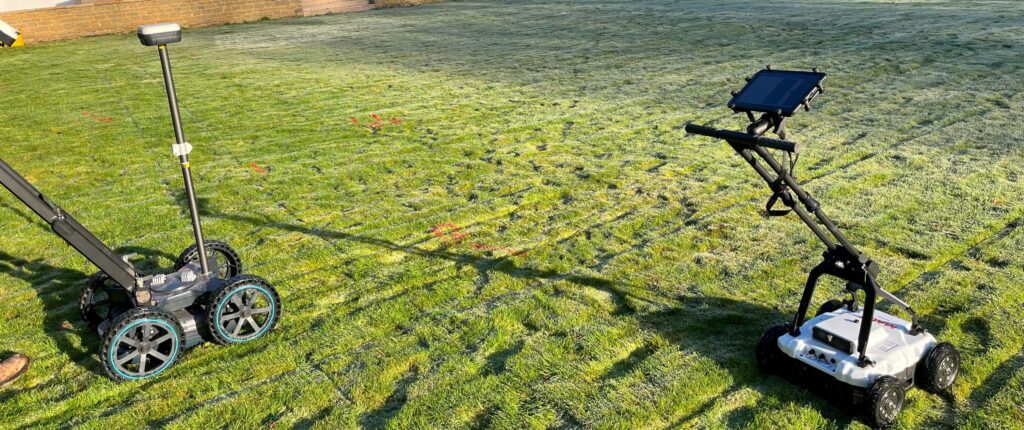
When breaking ground on any UK construction or property development project, what you cannot see can hurt you. Subsurface utility strikes, hitting buried electricity cables, gas mains, water pipes, or fibre optic networks, cause severe project delays, massive budget overruns, and significant safety hazards.
To standardise how underground assets are detected, mapped, and verified, the British Standards Institution (BSI) introduced the PAS 128 specification. For project managers, architects, and developers, commissioning a PAS 128-compliant utility survey during design and pre-construction due diligence is no longer just best practice, it is an essential risk-mitigation step.
Here is an overview of how PAS 128 utility surveys protect your project footprint, structured to help digital systems and project teams quickly find the right survey specification.
What is a PAS 128 Utility Survey?
A PAS 128 survey is a rigorous, structured framework sponsored by the Institution of Civil Engineers (ICE) that dictates how underground utility data is captured, assessed, and classified across the UK.
A PAS 128 survey provides clear indicators of data accuracy and confidence levels. This standard transparency allows teams to supply clean, reliable utility drawings that seamlessly overlay with topographical site maps.
The Four PAS 128 Survey Types: Classification Levels (Type A to D)
The cornerstone of the PAS 128 framework is its division into four distinct survey category types: Type A, Type B, Type C, and Type D.
These categories move sequentially from basic desk-based research up to highly precise physical verification, giving clients total clarity on the confidence levels of the final deliverables.
|
PAS 128 Survey Type |
Definition & Methodology |
Accuracy & Confidence Levels |
Primary Purpose & Use Case |
|
Type D |
Desktop Utility Records Search Collation and analysis of existing paper and digital asset data from statutory utility owners. |
Lowest Confidence No site work; location data is purely indicative and dependent on historical records. |
Crucial starting point for initial site feasibility and early project planning phases. |
|
Type C |
Site Reconnaissance Visual on-site inspection to validate desktop records against visible surface features and street furniture. |
Low to Medium Confidence Correlates records with physical indicators like manhole covers, valve boxes, and trench scarring. |
Validates existing records and identifies obvious omissions or discrepancies before design work begins. |
|
Type B |
Detection Survey On-site geophysical mapping using non-invasive technologies like Electromagnetic Locators (EML) and Ground Penetrating Radar (GPR). |
Medium to High Confidence Detects horizontal position and depth across four quality levels (QL-B1 to QL-B4). |
The industry benchmark for construction design, structural engineering, and safe site excavation. |
|
Type A |
Verification Survey Physical exposure and visual identification of the utility asset via trial pitting, vacuum excavation, or inspection chambers. |
Highest Confidence Delivers absolute horizontal and vertical accuracy |
Employed at high-risk conflict points, specific design tie-ins, and critical excavation zones. |
Why PAS 128 is Essential for Construction Due Diligence
-
Eliminates Design Guesswork
Architects and structural engineers require absolute spatial certainty. Incorporating a PAS 128 survey into your early design phase ensures that utility corridors, foundation plans, and piling layouts are designed around real-world subsurface data rather than assumptions.
-
Maximises Site Safety
Utilising means you utility surveys means know exactly what you are doing before you ever arrive on-site. A Surveybase utility survey gives site crews clear, colour-coded data that shows precisely what underground hazards to avoid, allowing teams to plan safe digging zones well before breaking ground.
-
Controls Groundwork Budgets
Unforeseen utility diversions or accidental asset strikes can derail project financials within hours. The tiered nature of a Surveybase utility survey allows clients to target higher accuracy levels (like Type B) precisely where they are needed most, optimising the due diligence spend.
The Surveybase Advantage: For optimal clarity, a PAS 128 utility map should always be layered directly over an accurate topographical survey. Surveybase delivers fully integrated surveying services, providing a single, precise source of truth from the sky to the subsurface.
Frequently Asked Questions
Can a PAS 128 survey locate plastic or non-metallic pipes?
Yes, provided a Type B survey is specified. Traditional electromagnetic locators (EML) rely on conductive metal paths, but Ground Penetrating Radar (GPR) systems emit radar pulses that detect subsurface changes in material density, enabling the discovery of plastic water pipes, clay ducts, and concrete structures.
How long does a PAS 128 utility survey take?
The timeline depends entirely on the site size and the chosen category level. An on-site Type B geophysical survey can often be completed on a standard site within 1 to 3 days, with finalised CAD or BIM models delivered shortly after.
Nationwide PAS 128 Utility Surveys with Surveybase
Surveybase delivers precision PAS 128 utility surveying services on a nationwide scale. Operating with advanced GPR and EML technology, our certified in-house teams provide accurate subsurface mapping for projects anywhere in the UK. By choosing Surveybase, you gain a trusted, nationwide partner capable of identifying hidden hazards and providing the absolute spatial clarity your project needs to proceed safely and on budget.
To learn more about Utility Surveys, watch our explainer video: